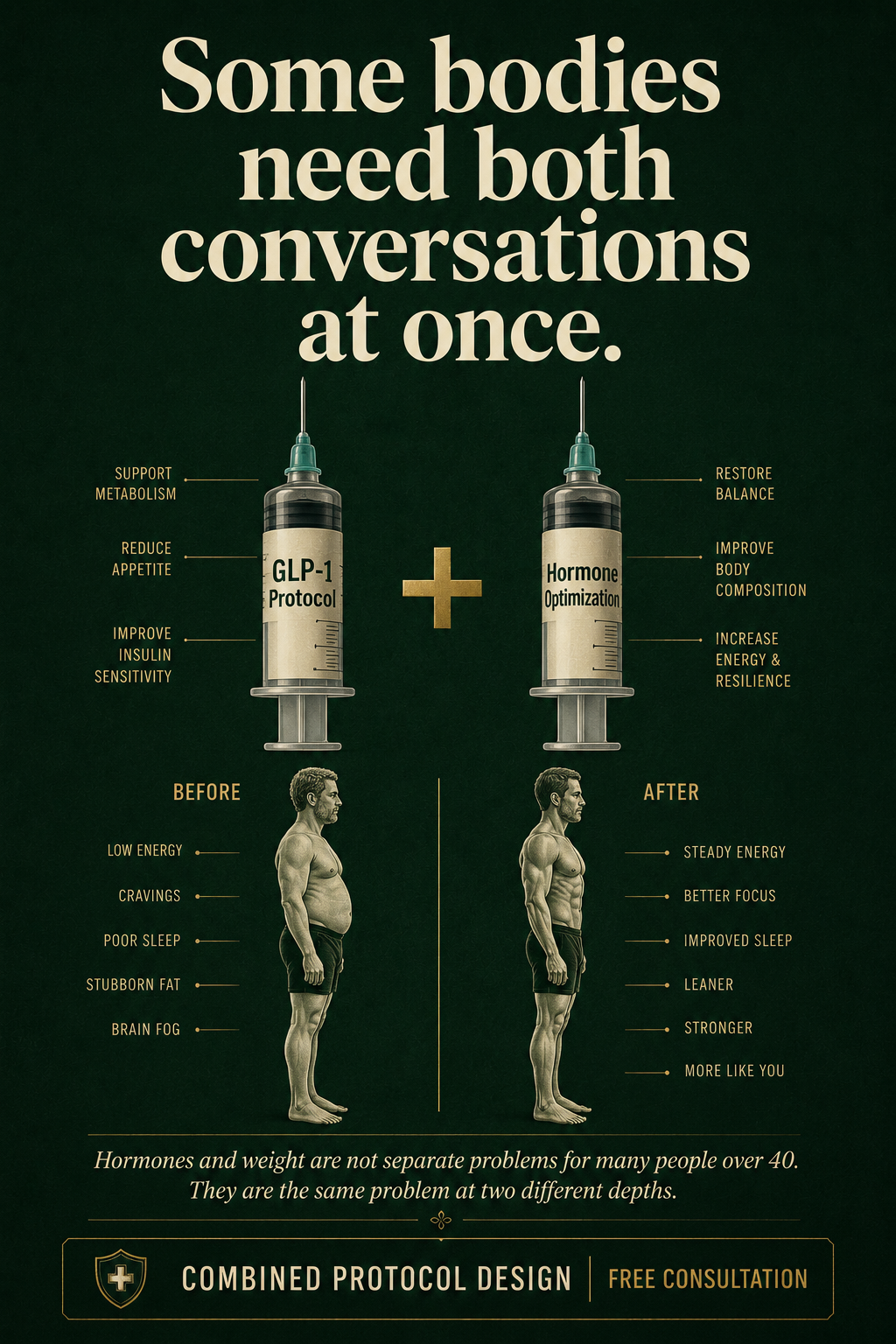
Weight and hormones are not separate conversations. They are the same conversation at different depths.
For a meaningful subset of patients — particularly those over 40 — the weight that is not responding to diet, exercise, or even a GLP-1 program alone has a hormonal component that is not being addressed. Treating only one variable when two are present produces incomplete results.
How low testosterone affects weight in men
Testosterone plays a direct role in body composition. It promotes muscle mass maintenance and fat metabolism — particularly visceral fat, the fat that accumulates around the organs and is most metabolically harmful.
As testosterone declines with age, muscle mass decreases and fat accumulates disproportionately in the abdominal region. This creates a self-reinforcing loop: more abdominal fat increases the enzyme aromatase, which converts testosterone to estrogen, which further reduces testosterone. The cycle continues independent of caloric intake.
Men with low testosterone have significantly higher rates of obesity and metabolic syndrome than age-matched men with optimal testosterone levels. Addressing both simultaneously produces body composition improvements that neither alone achieves.
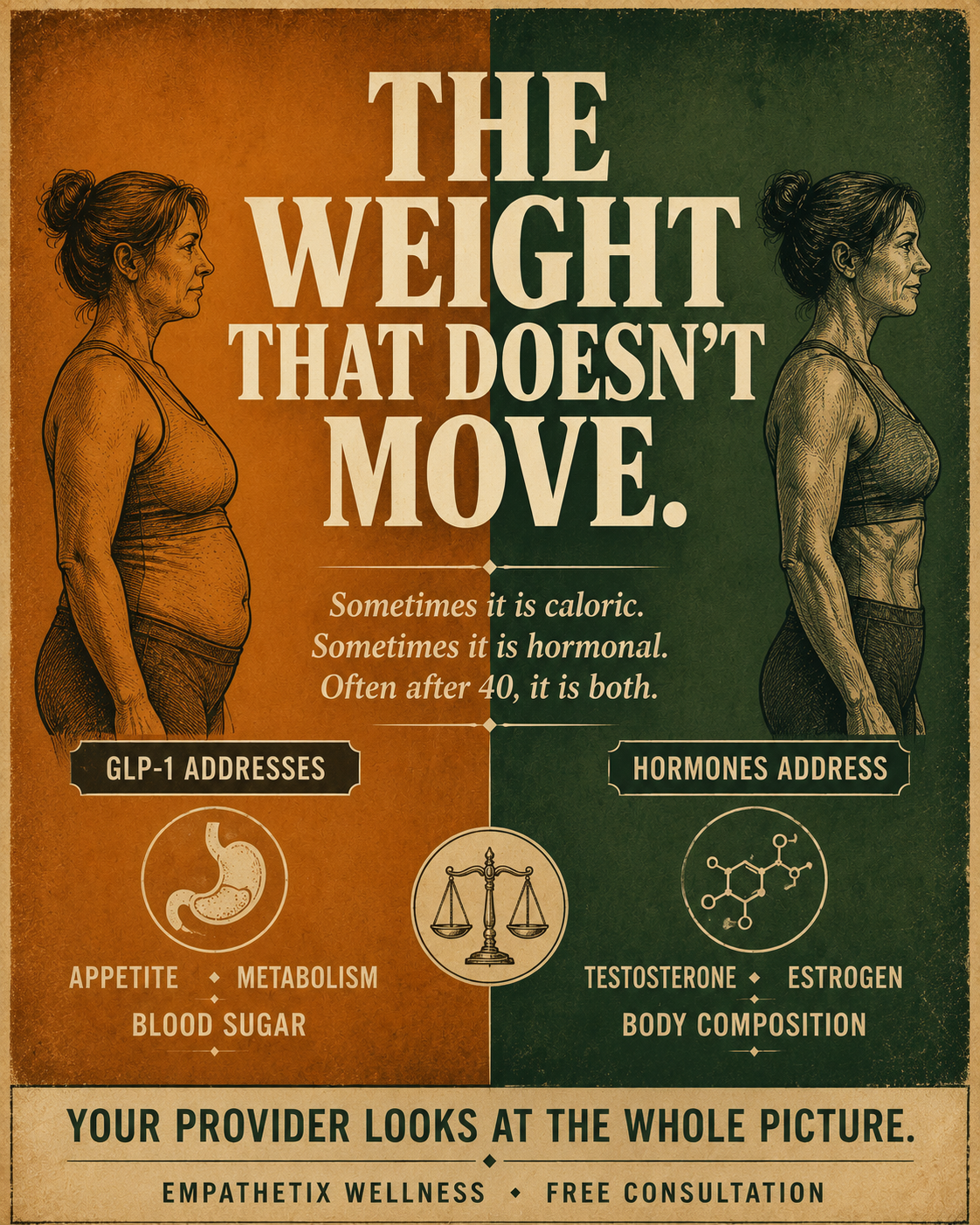
How hormonal shifts affect weight in women
The perimenopause and menopause transition brings declining estrogen and progesterone — and often declining testosterone — that profoundly affects metabolism, fat distribution, and the body's response to caloric restriction.
Women in hormonal transition frequently report that the same dietary behaviors that maintained their weight in their thirties stop working in their forties. This is not imagination. The metabolic environment has genuinely changed due to hormonal shifts.
A GLP-1 program running in a hormonally suboptimal environment is like trying to accelerate with the parking brake on. Both things need addressing for the full picture to change.
How Empathetix addresses this
A comprehensive hormone panel alongside a metabolic panel gives your provider the full picture. If both a GLP-1 protocol and hormone optimization are indicated, a combination protocol can be built. The clinical benefit of addressing both simultaneously — in appropriate candidates — is well-supported by the patient outcomes literature.
Not everyone needs both. Your provider makes the determination.
Ready to find out if a GLP-1 program is right for you?
The consultation is always free. A licensed provider
reviews your profile and gives you a straight clinical
answer - no commitment required. You only pay if a
protocol is approved for your situation.
Start with a free conversation →
Free consultation · Provider review within 24 hours ·
Ships in 2 days if approved
For informational purposes only — not medical advice. Results vary and are not guaranteed. All protocols require provider evaluation and approval before
anything is prescribed. Compounded medications are not FDA-approved finished drug products. Not all patients will be approved for treatment. Medical emergency? Call 911.
© Empathetix Wellness · empathetix.com ·
(801) 804-3166 · info@empathetix.com