
It does not happen overnight. That is what makes it so easy to miss.
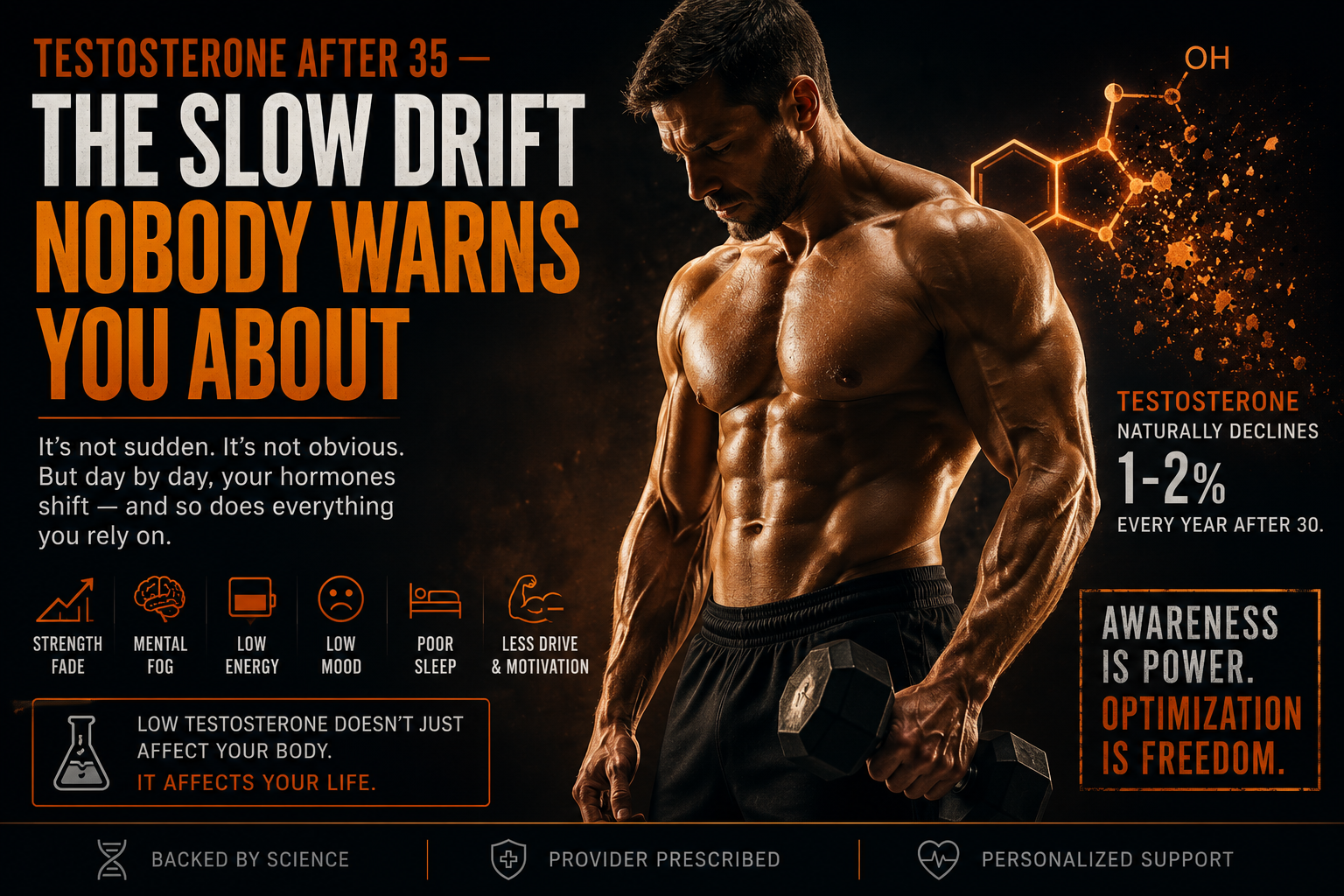
Somewhere around your mid-thirties, testosterone begins a quiet decline. About one to two percent per year. That is not dramatic. That is barely perceptible in any single year. But stack ten of those years together and something has genuinely shifted.
The energy that used to be background music has turned to background static. The drive that pushed you through hard weeks requires more effort to access. The muscle that once showed up when you trained stopped coming as reliably.
The most common thing men say is: I just thought it was getting older. It was — but getting older does not have to mean staying here.
What does low testosterone actually feel like?
- Fatigue that sleep does not fix
- Brain fog — not stupidity, just a softening of the sharpness
- Low libido — not absent, just quieter than you remember
- Loss of muscle despite training consistently
- Weight accumulating around the middle regardless of diet
- A mood that sits slightly flat — not depressed, just muted
Any three of these together is a signal worth investigating.
What does 'normal' actually mean?
Here is the part most standard bloodwork misses. The reference range for testosterone is broad — roughly 300 to 1000 ng/dL. A man at 310 is technically normal. He is also often symptomatic, exhausted, and being told his labs look fine.
Normal and optimal are not the same number. Provider-supervised testosterone optimization is not about pushing beyond what is healthy. It is about returning to what is genuinely functional for you.
What does the process look like?
Free consultation. Your coordinator asks the right questions.
Lab panel. Testosterone, estradiol, SHBG, LH, FSH, PSA, full metabolic panel.
Provider review. Your provider looks at labs and health history together — not just the number.
Protocol prescribed. Injectable, cream, or pellet depending on your clinical picture and lifestyle.
Still have questions before you decide anything?
That is exactly what the free consultation is for.
Talk to a provider — no commitment
For informational purposes only — not medical advice. Results vary and are not guaranteed. All protocols require provider evaluation and approval before
anything is prescribed. Compounded medications are not FDA-approved finished drug products. Not all patients will be approved for treatment. Medical emergency? Call 911.
© Empathetix Wellness · empathetix.com ·
(801) 804-3166 · info@empathetix.com